In a recent interview with KTSM-TV Channel 9, 81-year-old Judy Benjamin discussed her inspiring walk across the country from San Diego to Florida, celebrating both her birthday and nearly 900 miles traveled on foot. Diagnosed with Alzheimer’s at age 67, Judy shared how her journey aims to redefine aging and demonstrate the benefits of exercise — both physical and cognitive. Despite a strong family history of the disease, she credits consistent movement and a healthy lifestyle for her well-being, emphasizing that age and fear should never be barriers to taking on big challenges. She also expressed gratitude to her supporters, including CareScout, Apollo Health, and others, for helping make her mission possible.
I find myself pausing at the edge of the active runway at Wickenburg Municipal Airport. I pause to watch a small plane lift into the sky. I used to fly — first a Cessna 150, then a Cherokee. I miss it. But now, I’m crossing the country on foot, walking from San Diego to St. Augustine to raise awareness about Alzheimer’s — and the hope that still exists.
While in Wickenburg, I spoke to a Real Country KSWG FM radio host, Rick Kelly, about why I’m doing this. He was surprised to hear I was diagnosed with Alzheimer’s over ten years ago. Back then, my memory was fading. But with help from Dr. Dale Bredesen, I followed a personalized protocol: changes in food, sleep, exercise, supplements, and reducing toxins. Gradually, my symptoms began to reverse.
This walk isn’t about miracle cures. It’s about showing what’s possible. Cognitive decline doesn’t have to be a one-way street. That’s why I helped start The Alzheimer’s Survivors Foundation, a non-profit foundation focused on sharing practical strategies that can make a difference. I’m not promising miracles, but I don’t want people to feel powerless. My experience, and others like mine, show that decline isn’t always inevitable and can be prevented.
Don’t give up if you’re a caregiver or facing a diagnosis. Small changes matter. Something as simple as walking, just moving every day, can help more than you might think. There are great resources now. Dr. Bredesen has four published books, including his first, The End of Alzheimer’s, and his latest, The Ageless Brain, which I highly recommend. Look online for information and support communities working toward real solutions, like CareScout, a nationwide network providing in-home caregivers, resources, and dignity to all who need care.
I loved my stop in Wickenburg. It was such a charming town with a cowboy history, which made me want to buy a cowboy hat. If I hadn’t had the walk to focus on, I might have been tempted to stay and be a cowgirl.
Until next time,
Judy
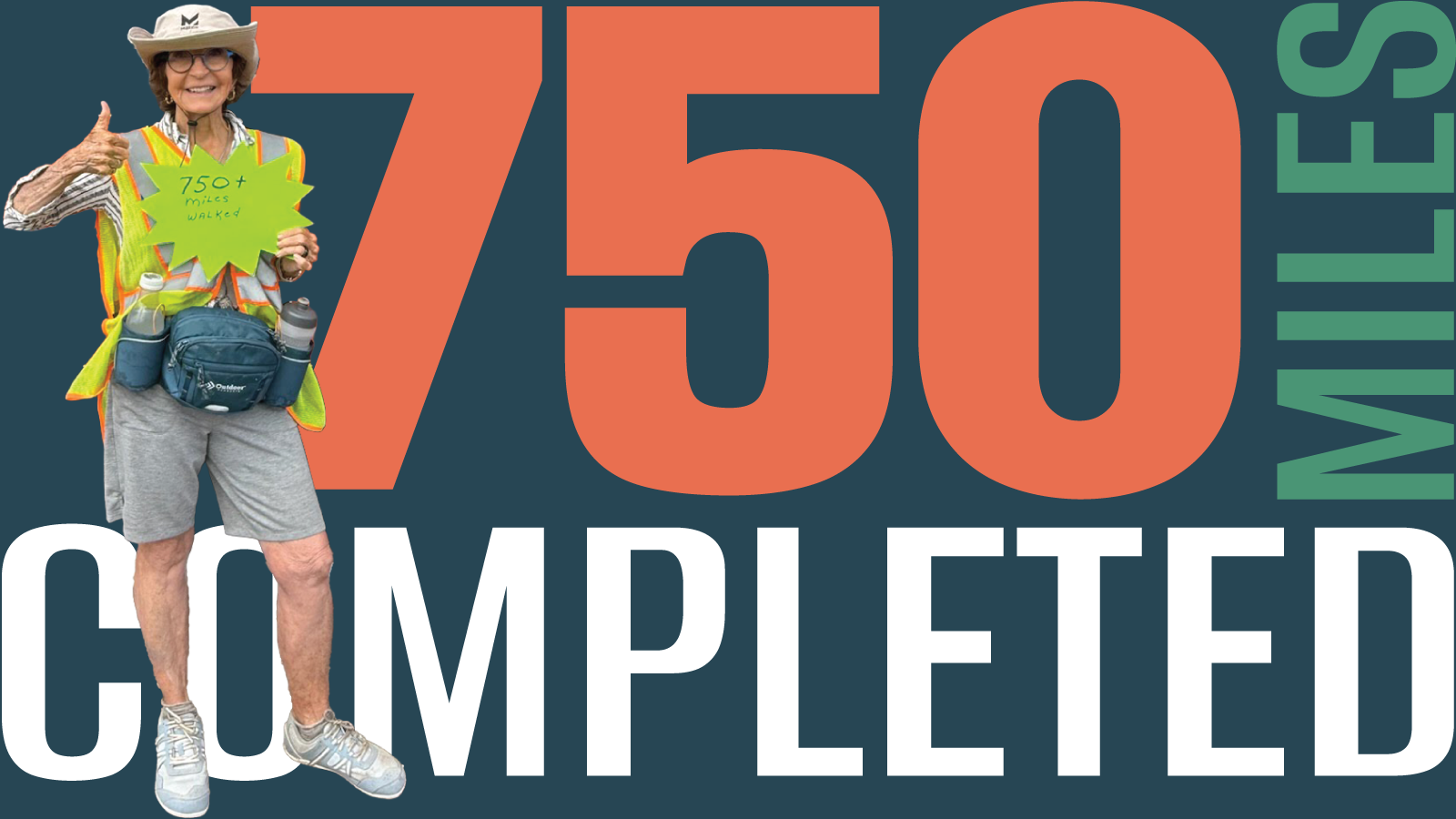
It’s hard to believe, but I’ve walked over 750 miles! I crossed into New Mexico and passed Safford and Franklin, Arizona, both of which had stunning desert landscapes. Lordsburg and Deming came next, with broad skies and low horizons before me.
Signal and Silver City brought a change in scenery and elevation. Silver City had an artsy, almost whimsical energy to it. I am now in Hatch, known for its famous green chiles. I’ve met people from all walks of life, many struggling with their own health or caring for someone with cognitive issues. They listen to my story; I listen to theirs, and we connect. This walk is about hope, memory, and the threads that tie us together. I feel it with every step.
I am reflecting on my walk on California’s historic Highway 111, built in the 1930s to accommodate the growth fueled by the Southern Pacific Railroad. The highway stretches approximately 130 miles, passing through key cities like Indio, Calipatria, and Palm Springs, dotted with sand dunes and interspersed with green fields, hay bales, and cattle farms. I witnessed hay being cut and bailed, along with numerous other agricultural activities in this area. This stretch was cloudless, and the air was still. I was grateful for the occasional breeze. I added walking sticks to my armature. They seem to propel me forward at a faster pace and provide the additional benefit of strengthening my arms, even though using them requires more energy.
As I was heading towards Brawley, Mike, my videographer and driver, congratulated me on completing 200 miles (we had accomplished that a bit earlier). He made a sign out of cardboard and took my picture to commemorate the occasion. At one point, I was descending the hilly dunes, which were challenging because there was no shoulder. I had to jump to the side of the road when fast-moving, large trucks passed. Those maneuvers really slowed me down. Safety first, I would rather jump over than meet the oncoming traffic!
By now I walk at a comfortable easy pace and feel great. The blisters that plagued me in the early days of the walk have healed. My feet have adjusted to walking for more than eight hours a day. One night, on a lonely stretch of desert road, we camped next to the roadside. Hearing an unfamiliar sound coming from the brush, we discovered a few stray donkeys. It was nice to encounter some wildlife along the way. In addition to the donkeys, I have seen one live snake, two dead ones, and many lizards.
A number of people posting on social media about my walk have asked what I do to stay healthy, and specifically what I have done to reverse my memory loss. The answer is complicated with so much to discuss, but gathering information about your body is one of the first steps. Find out where you stand by getting tested to learn about your body’s inflammation levels, glucose levels, and whether you are insulin resistant or not. Find a good practitioner, a coach, or a nutritionist trained in the Bredesen Protocol. Free cognitive assessments are available online. As the saying goes, “you can’t manage what you don’t measure.” Start with the basics: daily exercise, a healthy diet of fresh food, and restorative sleep. I’m not going to tell you that it is easy to get your brain back to a healthy state, but I am proof that it is possible if you are willing to do the work. Age shouldn’t hold you back, promise yourself to make some area of your life better each day. Apollo Health has a practitioner locator tool to help you do that. Enter your zip code here to find a practitioner ideally near you, but one farther away is OK too. Telehealth enables us to get the expert help we urgently need. For more information on the first steps toward your healing journey, email info@ahnphealth.com.
Until next time,
Judy
It’s hard for me to believe that I’ve already walked more than 500 miles! Looking back at some of the video footage, including the drone shots which show the incredibly beautiful landscapes and long stretches of roads, memories flashed before me. The small towns and settlements each with their unique features and charm. But what has been most impressive have been the people I’ve met. As soon as they learn what I’m doing and why, they are immediately interested. Everyone identifies with cognitive decline and Alzheimer’s, either because a family member has been affected, or sometimes they admit they are personally experiencing symptoms of memory loss. A runner stopped me as I was crossing the Colorado River bridge. He ran across America twice and even ran the perimeter — he is so much younger and fitter than I am. He hugged me, wished me well, and made a small donation with all the cash he was carrying! Everyone who hears about the walk wishes me well. Sometimes people see my support van with the placards about the walk, they honk their horns, and wave.
Several people have stopped along the highway and offered water. Others offer rides, which I kindly refuse. We spent an amazing evening with a group of people in a settlement of RVs and tiny houses at DeAnza Springs Resort in Jacumba Hot Springs. A magical place tucked between mountains. People come from all over to enjoy the hot springs. A long-term resident, a vivacious woman in her late 60s, married to a Sicilian, regaled us with stories. Two friends rounded up the group. One was a gentleman of around 70 suffering from cancer. The love and support of his friends was palpable. Sadly, he was still smoking. The other gentleman was also ill with diabetes and other ailments and was still smoking. What was striking was the closeness and love expressed by their neighbors. Truly an example of what the word community can mean. We sat on their patio, wine and beer were offered but not accepted. Clearly, they were happy and having fun. Loving their life despite their challenges. They asked many questions about how I have reversed my symptoms. They are following me on Instagram.
Further down the road, I walked into what I thought was an antique shop, but learned it was a collection of objects of art. The owner, an artist, had turned castaway junk into beautiful art. People everywhere are kind and express intense interest in the purpose of my walk. The walk through the Apache Indian Reservation took 3 days. Two Apache sisters driving past me turned their car around to take a photo with me. I will treasure that photo. Another young Apache man stopped me and asked how far I was walking. When he heard, he said he was going to pray that I would be safe on my journey. I thanked him and said I could use his prayers.
Each day has been an adventure, convincing me that my journey is worthwhile and having an impact on those people I meet.
Until next time,
Judy
Dr. Judy Benjamin met with Kathy Bernard, host of The Grands Podcast, to discuss her 3,000-mile walk from San Diego to St. Augustine, Florida. They talked about her early-stage Alzheimer’s diagnosis at age 67, including her family history, her mom and uncles passed away from the disease. She spoke of the panic she felt after diagnosis, and how her doctor told her she would end up like her mom, and there wasn’t anything that could be done. A friend introduced Benjamin to Dr. Dale Bredesen’s theory about Alzheimer’s, and she flew out to meet him, becoming his “patient zero,” and adopting his approach to treating cognitive decline. Benjamin also shared how, through blood tests curated by Dr. Bredesen, she identified the contributors to her decline, which included toxins created by mold in her home. It wasn’t just mold toxins that she had to mitigate; she also had to address the multiple causes of her decline to heal and improve. Benjamin shared the many changes that led to her recovery on the podcast and her reasoning for undertaking this monumental walk.
Watch Judy on The Grand Podcast here.
On April 12th I celebrated the 13th anniversary of when I started my journey to wellness and recovery from memory loss with Dr. Dale Bredesen’s protocol. The rough course today challenges my resolve. The wind pushes me forward and back. The narrow ledge on the shoulder limits my walking space. But my walk is a journey, not a race. I don’t feel pressured to meet impressive daily mileage. With excellent team support, and all the wonderful followers cheering me on–I am confident that I will reach my destination. As I continue, I encourage followers to experience with me the excitement of walking across America. Perhaps, walk and talk with me whenever possible.
My route today is along the lengthy road that intersects the two thousand square mile Yuha Desert, parallel to Interstate 8 towards El Centro in the Imperial Valley—which drops below sea level. The pace is manageable and easy but after an hour or so walking on the hot asphalt, my feet heat up. You could say I’m “hot footing it” across the desert! After a couple of hours walking, I need to take breaks in my support RV to remove my shoes and cool down. Thanks to one of my sponsors, UCAN, I boost my electrolytes with their excellent hydration and energy gel packs.
Another sponsor, Trifecta, provides delicious meals for myself and Mike, my support driver and videographer. Not only are they very tasty but they have saved us valuable time since all that is needed is to warm up the food. Don’t get me wrong, I like cooking, but it is enormously helpful to have healthy prepared food and save the time it would take to shop and prepare from scratch. That time and energy is best used for walking and recovering. Sadly, finding sources for healthy food across my walking route isn’t easy. That speaks to the difficulties encountered by the general population in rural areas.
Today, I encountered around 15 to 20 dune buggies off-roading and kicking up sand as they passed through the beautiful sand dunes. Luckily, the wind blew the sand away from me, but I put away my camera briefly as a precautionary measure. I am rarely bored on the long stretches of my walk, which gives me a lot of time to ponder and reflect. I enjoy listening to my weekly online class on the James Joyce novel, Ulysses. What a different experience now from when I first read Joyce as a college student! I’m greatly enjoying listening to Dr. Bredesen’s new book, The Ageless Brain, as I walk. I highly recommend it to everyone.
Catch you further down the road,
Judy
Dr. Judy Benjamin appeared on the Good Morning Arizona Show this May. She spoke with anchors Kylee Cruz and Alaina Kwan about her 3,000-mile walk across the country and the reasons she undertook the journey. Benjamin encouraged others to take their brain health into their own hands, explaining that there are things you can do to reverse cognitive decline, as she has. She described her healing journey, which began over a decade ago after being diagnosed with early-onset Alzheimer’s, when she adopted Dr. Dale Bredesen’s approach to treating cognitive decline, becoming his “patient zero.” Among the many things she shared on the show was that her Mom passed away from Alzheimer’s, and in part, this walk is in her honor as well as to get the message out across the country that something can be done. Watch on YouTube.
As I am heading closer to the California-Arizona border, I am walking uphill and feeling a little breathless because of the climb; these are the first of many climbs I will be making as I move along, and it has been a great way to test my endurance and stamina. I’ve enjoyed the beautiful scenery, the cows in the pasture, and the desert chaparral so far. This is a great way to see the country and meet folks who stop me and ask what I’m doing on the road.
I’m trying not to be stressed about how many miles I walk daily. After all, this is not a race; it’s a journey. I’ve been thinking about my original goals, ideas, and estimations. But now, in the thick of it, I realize that the temperature, terrain, and blister on my right foot tell me that I need to be kind to myself and be okay with not clocking as many miles as I expected to. We give ourselves a day of rest weekly to regroup and prepare for the next day. Following that day of rest, I am energetic and excited about what the day and the next set of miles will bring me.
Looking at the roadside memorials for loved ones who have perished on the highway reminds me of the dangers of the road, whether in a car or on foot. I am always mindful of my safety and aware of my surroundings. Some of the pavement on the side of the highway is broken up and is unforgiving on my blistered foot, and since I can hear cars coming from a long way off, I sometimes let myself walk on the smoother pavement in the road. I also wear a bright yellow reflective vest to ensure I’m well seen.
Another welcome sight is my support vehicle ahead of me, adorned with the orange placards provided by CareScout. My driver and videographer, Mike, pulls over after a certain distance down the road, and I eventually catch up to him. The RV is carrying my supplies, and I can stop for a bit, take a break, and grab something I need. It’s my moving goal post, and breaks up the long, lonely stretches of road.
So far, I’ve passed through many small and mid-sized towns in California. One such town, El Centro, is one of the lowest elevations in the United States and an agricultural town producing much of California’s winter vegetables. I have also reached Laguna Summit, formerly called “Laguna Junction,” a roadside café built in 1916 and removed in 1971 to make an interchange on the I-8 highway where I’ve been walking this week.
Until next time,
Judy
I’m a little over a week into my journey, which started on April 5th in San Diego. The Arizona border lies ahead as we head toward Blythe, Calif., located in the Palo Verde Valley of the lower Colorado River Valley Region. I have loved telling my story of hope and possibilities for better brain health to the inquisitive people who stop me by the side of the road. I want them to know that there is another way of living, and they can make the most of their lives and take charge of their health.
It is quite an experience to see America from the roadside and at eye level. As I walked through the Imperial Valley, I was struck by the natural beauty of the roadside view of nature as I pounded the pavement. It allowed me to clear my mind and reflect on this first week of my journey. It has been productive and successful, minus the dust devils and technical issues with uploading my video updates, but we are working that all out. We had to stop so the whirling sand didn’t work into our tech gear and temporarily stop using the drone, which was also throttled by the high winds.
I have two new supporters to add to my roster of sponsors, Jennie Kasteler and her brother, Calvin Child, who has donated GDG protein bars from his company. They have been handy and a perk to keep me going. I must give another shoutout to Trifecta Nutrition, whose KetoFLEX 12/3 meals my videographer, Michele “Mike” Gentile, and I have also enjoyed this week. Both sponsors are keeping the fuel in my tank, so to speak.
What’s on the road ahead of me now? I know many small towns and communities that need to hear about the Bredesen Protocol and Dr. Dale Bredesen, as well as the message of hope that something can be done about cognitive decline. It’s the metaphorical torch I am carrying on their behalf.
Catch you further down the road,
Judy