Octogenarian Aims to Become First Alzheimer’s Survivor to Walk the Width of England
LAND’S END, England, July 13, 2026 /PRNewswire/ — At 09:00 a.m. British Summer Time on August 1st this year, 82-year-old Dr. Judy Benjamin will set out from Land’s End on an extraordinary 550-mile journey across England, aiming to become the first known Alzheimer’s survivor to complete the trek while carrying a message of hope for millions affected by cognitive decline. Diagnosed nearly fifteen years ago, Benjamin is living, lively proof that cognitive decline is no longer a death sentence.
Her walk will conclude in Central London in mid- to late-September after passing through Cornwall, Devon, Winchester, the South Downs, Dover, Canterbury, and Greenwich. Along the route, Benjamin will share her story and raise awareness of growing evidence suggesting that cognitive decline is preventable and, in many cases, reversible through a personalised, precision-medicine approach called ReCODE.
For Benjamin, the journey is deeply personal. Her mother endured a 20-year battle with Alzheimer’s disease, and four of her uncles also died from the illness. When Benjamin herself was diagnosed with Alzheimer’s in 2011, she nearly gave up hope.
Then a chance meeting with neurologist and Alzheimer’s researcher Dr. Dale Bredesen changed the trajectory of her life. As one of the earliest patients to follow his personalised ReCODE Protocol™, Benjamin embraced a comprehensive programme focused on nutrition, exercise, sleep, stress reduction, and identifying the underlying contributors to cognitive decline.
“This walk is about showing people that there is hope,” Benjamin said. “Too many patients and families are told there is nothing they can do. I want people to understand that lifestyle, nutrition, sleep, movement, stress reduction, and identifying the root contributors to cognitive decline can make a profound difference. Alzheimer’s survivors exist, and it’s time the world sees that.”
Benjamin’s English trek follows another remarkable achievement. In 2025, she completed a 2,790-mile walk across the United States, traveling from San Diego, California, to St. Augustine, Florida, becoming the first known person diagnosed with Alzheimer’s to walk across America. Her journey helped spark broader public conversations about prevention, early intervention, metabolic health, and the possibility of life after diagnosis.
“Fourteen years after her diagnosis, Judy continues to inspire people around the world,” said Dr. Dale Bredesen, internationally recognised neurologist and author of The Ageless Brain and million-seller The End of Alzheimer’s. “Her determination, resilience, and energy challenge what many people believe is possible after an Alzheimer’s diagnosis. She is a living example of what can happen when cognitive decline is addressed through a comprehensive, personalised approach.”
Throughout the walk, Benjamin and her supporters will share updates, interviews, and educational content focused on brain health, healthy aging, and Alzheimer’s prevention. The journey will also support the mission of the Alzheimer’s Survivors Foundation, which Benjamin founded to advocate for individuals living with cognitive decline and amplify stories of recovery, resilience, and hope.
Among the sponsors supporting Judy’s UK walk are Apollo Health, LifeSeasons, Vielight, CareScout, UCAN, and Xero Shoes. Additional organizations interested in supporting Judy’s mission to raise awareness of brain health and Alzheimer’s prevention are welcome to join the effort.
With nearly one million people living with dementia in the United Kingdom and tens of millions more worldwide, Benjamin hopes every step toward London will encourage people to rethink what may be possible after a diagnosis—and inspire them to take action to protect their brain health regardless of age. To keep up with Judy during this historic walk, you can track her progress by visiting JudyWalksTheWorld.com.
Media Contact:
Laura Lazzarini
laura@ahnphealth.com
London is calling.
On August 1, I’ll begin my walk across England, starting at Land’s End on the country’s rugged southwestern tip. From there, I’ll walk nearly 550 miles to London, continuing my mission to raise awareness that cognitive decline is not an inevitable part of aging.
Before setting out, I wanted to spend a few days in England learning, preparing, meeting people, and imagining what it might feel like to finally walk into London after weeks on the trail. Those few days turned out to be meaningful—not because of any single event, but because they reminded me that every worthwhile journey begins long before the first mile.
One of the highlights of my visit was attending the Integrative & Personalised Medicine Congress. I enjoyed hearing physicians, researchers, and healthcare professionals discuss the expanding role of personalized medicine and the remarkable progress being made in brain health. I left encouraged by the number of people in the United Kingdom who are asking thoughtful questions about Alzheimer’s prevention and lifelong cognitive wellness.
I was especially honored when Dr. Kat Toups mentioned my story during her presentation on the Dementia Reversal Trial. Her comments sparked several conversations with attendees who wanted to learn more about my own experience and why I’m preparing to walk across England. Those conversations reinforced something I’ve come to believe deeply: when we share our stories, we give others permission to ask questions, challenge assumptions, and explore new possibilities.
One of my favorite experiences was finally meeting six Apollo Health coaches from across the UK. We’d spent hours together on Zoom, but meeting face-to-face was something entirely different. Their enthusiasm for this journey was contagious. They have already begun helping with logistics and planning, and several hope to join me for portions of the walk. Knowing that I’ll occasionally share the trail with friends makes the adventure feel even more special.
The week also included plenty of practical preparations. We recorded videos for social media, met with potential supporters, and searched for the perfect place to finish the journey. We found it in Victoria Tower Gardens, a peaceful park beside the River Thames and adjacent to the Palace of Westminster. Shaded by mature trees, easily accessible by public transportation, and offering a beautiful setting, it immediately felt right. Standing there, I could almost picture the moment weeks later when I cross the bridge, walk into the park, and complete this remarkable journey.
One afternoon, a friend drove me to Canterbury, where we visited St. Martin’s Church, the oldest church in England to have held continuous weekly services. I learned that some of my distant relatives were married there centuries ago. Sitting quietly in the ancient chapel and wandering through its gardens, I found myself imagining what life must have been like in the 1600s. It was an unexpectedly moving experience, and I felt a surprising connection to a place I’d never visited before.
Canterbury has welcomed pilgrims for centuries, and soon it will welcome another. During the final days of my journey, I’ll walk part of the historic Pilgrims’ Way before continuing on toward London. It seems like a fitting reminder that every generation has its own pilgrimage. Mine happens to be one of hope — hope that we can change the conversation about aging, protect our brains, and inspire others to believe that it’s never too late to take the first step.
Until next time,
Judy
In her conversation with Lisa Feiner, co-founder of Sharp Again Naturally, Judy Benjamin reflects on her Alzheimer’s diagnosis, the changes she made to support her cognitive health, and the lessons she has learned over the past 15 years. She discusses the importance of nutrition, movement, sleep, stress management, and taking an active role in maintaining brain health.
Judy also talks about the motivation behind her upcoming walk from Land’s End to London, which aims to encourage conversations about Alzheimer’s prevention, early action, and healthy aging. Throughout the interview, she emphasizes that people can take meaningful steps to support their brain health at any stage of life.
Watch Here:
When I was diagnosed with Alzheimer’s at 67, I had already watched my mother spend 20 years slowly disappearing to this disease. I knew what the conventional story looked like, and I refused to accept it as my own.
Instead, I made major changes to my diet and lifestyle. I became Dr. Dale Bredesen’s original “patient zero,” adopting a clinically validated protocol designed to treat and prevent cognitive decline. That decision changed everything. My recovery inspired me to become a ReCODE-trained coach with Apollo Health and to dedicate my life to helping others take action earlier, live healthier, and believe, as I do, that cognitive decline can be prevented and, in many cases, reversed.
In 2025, I walked across America. All 2,790 miles of it, from San Diego, California, to St. Augustine, Florida. I wanted the world to understand that Alzheimer’s survivors exist. That journey was more than an athletic feat — it was a living demonstration of resilience, healthy aging, and the possibility of real life after an Alzheimer’s diagnosis.
Now I’m taking that message across the Atlantic.
I’m walking from Land’s End to London starting on August 1, 2026, and every mile carries the same message I’ve lived and proven through my own experience: Alzheimer’s does not have to be a story of inevitable decline.
At an age when many people are told to slow down, I’m choosing to step forward literally on behalf of the millions of individuals and families affected by Alzheimer’s, cognitive decline, and fear of what the future holds. Along the route, I hope my story serves as a powerful reminder that we are not helpless in the face of this disease, and that meaningful action can begin long before advanced disease takes hold.
This walk is about raising awareness, building community, and inviting people into a new conversation about brain health — one centered on prevention, early intervention, lifestyle, metabolic health, and hope.
This is not simply a walk from one place to another. It’s a public statement of courage, science, and possibility.
There is hope after an Alzheimer’s diagnosis. Alzheimer’s survivors exist. And it’s time for the world to know.
In a wide-ranging interview with Dr. Heather Sandison on the Think Well Age Well podcast, Judy Benjamin reflected on her journey from an Alzheimer’s diagnosis at age 67 to becoming a leading voice for hope, resilience, and action in brain health. After watching her mother decline from Alzheimer’s, Benjamin recognized early cognitive changes in herself and sought out researcher Dale Bredesen, whose emerging precision-medicine approach would later become known as the ReCODE Protocol.
Benjamin described the early stages of her recovery, including targeted testing, supplementation, dietary changes, improved sleep, toxin avoidance, and stress reduction. Within weeks of implementing these changes, she experienced a return of clarity and executive function. This experience reshaped her life and ultimately led her to become a certified ReCODE coach, supporting others navigating cognitive decline.
Eighty-one-year-old Benjamin recounted her journey of more than 3,000 miles across the United States to raise awareness that Alzheimer’s is not necessarily a one-way trajectory. Walking eight to twelve hours a day from San Diego to St. Augustine, she met thousands of people along the way, sharing her story and reinforcing a central message of the interview: aging is not defined by a number, and with commitment and the proper support, cognitive health can be reclaimed at any stage of life.
In an interview with Dr. Manna Semby, Alzheimer’s survivor Judy Benjamin described her experience after being diagnosed with early-stage Alzheimer’s disease in 2011 at age 67. Fourteen years later, at age 81, Benjamin is walking 3,000 miles across the United States, raising awareness about brain health and early intervention.
During the interview, Dr. Semby contrasted Benjamin’s outcome with that of British broadcaster Fiona Phillips, who was diagnosed with early-onset Alzheimer’s disease in 2021 at age 61. Four years after diagnosis, Phillips requires assistance with daily activities such as dressing and bathing, according to her husband, Martin Frizell.
Both women had strong family histories of Alzheimer’s disease and were diagnosed at early stages. The difference, as discussed in the interview, was how each responded following diagnosis. Benjamin pursued a comprehensive, multi-factor intervention addressing diet, physical activity, sleep, metabolic health, hormones, inflammation, stress, and cognitive training years before such approaches gained wider recognition.
The interview underscored the importance of the early-stage window in Alzheimer’s disease, when the brain retains greater capacity for stabilization and improvement. According to Dr. Semby, actions taken in the months and years surrounding diagnosis may play a critical role in determining long-term outcomes.
See Dr. Semby’s complete blog, Two Women: One Diagnosis, Two Strategies, Two Outcomes.
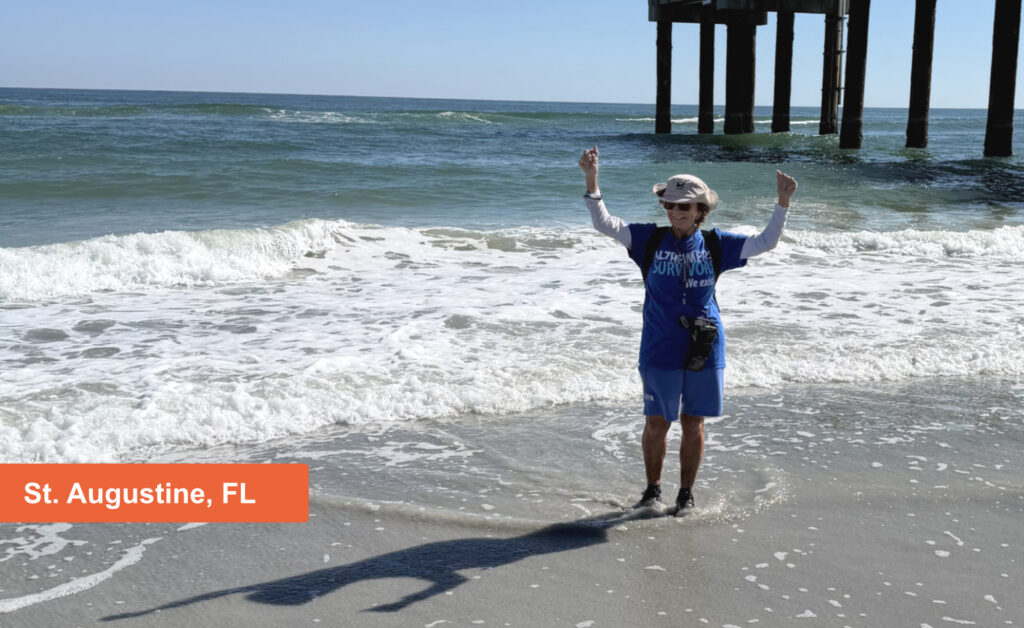
Judy Benjamin has finally reached the Atlantic, and on Saturday, November 15, dipped her toes into the water on Florida’s St. Augustine Beach. During her walk, she met hundreds of people across America, all curious about what that woman in a bright yellow safety vest, shaded under a red umbrella, walking alone on the side of the road, was doing. This gave her the chance to let them know that something can be done to prevent and reverse cognitive decline.
She crossed eight states: California, Arizona, New Mexico, Texas, Louisiana, Mississippi, and stepped into Georgia before ending up in the historic town of St. Augustine, Florida, after walking over 2800 miles. Among the countless historical and unique cities Judy crossed through, historic St. Augustine was founded by Spanish explorer Pedro Menéndez de Avilés in 1565, making it the oldest continuously occupied European settlement in the United States. Judy will now take a well-deserved rest and head back to her family and cats. We will hear more from Judy about her momentous walk across America soon, so stay tuned here.
In a recent live webinar, Judy Benjamin sat down with Dr. Dale Bredesen to discuss the final stretch of her 3,000-mile walk across America. Streaming in as she approached the Atlantic Coast, Judy reflected on her journey from San Diego to Florida — a mission undertaken to raise awareness about brain health, prevention, and hope after an Alzheimer’s diagnosis.
During the conversation, Dr. Bredesen commended Judy’s perseverance and called her story “an inspiration for anyone facing cognitive decline.” He noted that her recovery through the ReCODE Protocol, a precision medicine approach for treating early-stage Alzheimer’s, illustrates how lifestyle and metabolic interventions can improve cognitive function even after symptoms appear.
Judy shared that her daily walks, nutrition through the KetoFLEX 12/3 diet, and focus on sleep and stress management were central to her turnaround. “This walk is not just about crossing a finish line,” she said. “It’s about showing people that it’s never too late to reclaim your health.” The webinar served as both a celebration of her nearing the Atlantic and a reminder that the path to prevention begins with taking one step at a time.
Read the full segment on YouTube
FOX 10 News reporter Shelby Myers caught up with 81-year-old Judy Benjamin as she walked past the WALA-TV studios in Mobile, part of her 3,000-mile journey from San Diego, California, to St. Augustine, Florida. Benjamin began the walk in April to raise awareness about Alzheimer’s prevention and the power of lifestyle change.
Diagnosed with early-stage Alzheimer’s at 67, Benjamin sought help from neurologist Dr. Dale Bredesen, whose precision-medicine approach focuses on reducing brain inflammation through diet, exercise, sleep, and other healthy routines. “What have I got to lose?” she recalled asking before adopting the program that helped reverse her symptoms.
Now averaging 18 miles a day with a support driver nearby, Benjamin hopes her message inspires others to take early action. “There are things you can do about it,” she told FOX 10. “Don’t give up hope.” She plans to continue east along the Gulf Coast, crossing the Mobile Causeway on her way to Florida.
This week, I crossed another milestone on my coast-to-coast journey — 2,000 miles and counting. Each step reminds me why I started: to share hope that cognitive decline can be prevented and reversed.
Along the way, I also had the chance to join Dr. Dale Bredesen for a webinar. We discussed the everyday practices that keep me on track, including Keto-Friendly meals, daily walking, solid sleep, and stress management — and how these small, consistent steps add up to real change. Dr. Bredesen shared why putting these pieces together matters, and I explained how I make them work on the road, whether that’s choosing simple staples at diners or adjusting my plans when detours happen. If you missed the webinar, you can catch the recording here.
I’m writing today from New Orleans, where I’ve spent the last few days walking across this sprawling city. With over 2,000 miles now behind me, I can hardly believe I have fewer than 1,000 left before I step into the Atlantic Ocean at St. Augustine. My target is just before Thanksgiving, weather permitting.
Physically, I feel strong. No blisters, no joint pain, something I attribute to pacing myself, changing shoes and socks often, and relying on my trusty Xero barefoot shoes. They have kept me balanced and blister-free since I began my walk. Safety remains my biggest daily challenge — sharing the road with traffic requires focus, visibility, enhanced by my bright red umbrella and yellow dresses. Drivers, especially truckers, have been incredibly respectful, often moving over a lane to give me space. I’m thankful for their courtesy and for the countless good Samaritans who stop to offer water or simply a kind word.
Of course, this walk isn’t only about the miles. My mission is to spread hope: that Alzheimer’s is not an automatic death sentence, and that survivors like me do exist. Nearly everyone I meet has a loved one touched by this disease. I hand out cards directing them to the Alzheimer’s Survivors Foundation, so they know there are resources, stories, and a community waiting for them. I share my own story because I remember what it felt like to hear the words “there’s nothing we can do.” I refused to accept that and have shown that if you’re willing to do the work and follow the Bredesen Protocol, there’s plenty you can do to reverse symptoms. It works for me and can work for you too!
I still have hundreds of miles to go, but every step brings me closer to my goal. I walk with the memories of my mother, with the encouragement of strangers, and the deep conviction that the message of prevention and reversal must reach every family that needs it. Thank you for following along, cheering me on, and helping me carry this message forward.
Until next time,
Judy